When Does a Complaint Become a Dispute?

Companies know how to identify an angry customer. What is much harder is recognizing when a complaint has become a dispute.

They are not the same thing.

An angry customer may still believe that customer service will resolve the problem. A calm and polite customer, however, may already have concluded that the company is not listening and that there is no point in continuing the process.

The transition occurs when the parties reach a deadlock: the customer repeats their story, the company repeats its policy, and neither side can create movement.

At this stage, the language also changes. The customer is no longer talking only about a refund, repair, or compensation. They begin using phrases such as “This is unfair,” “You ignored me,” or “It has become a matter of principle.”

The most important signal, then, is not the intensity of the customer’s anger.

It is that the normal process is no longer moving the parties toward a resolution.

This is the moment when the company should stop treating the case as a routine customer service complaint and activate a different process: a structured dispute resolution process.

A company that recognizes this moment early will not prevent every disagreement. But it may prevent a small complaint from becoming a legal claim, a public crisis, or a lost customer.

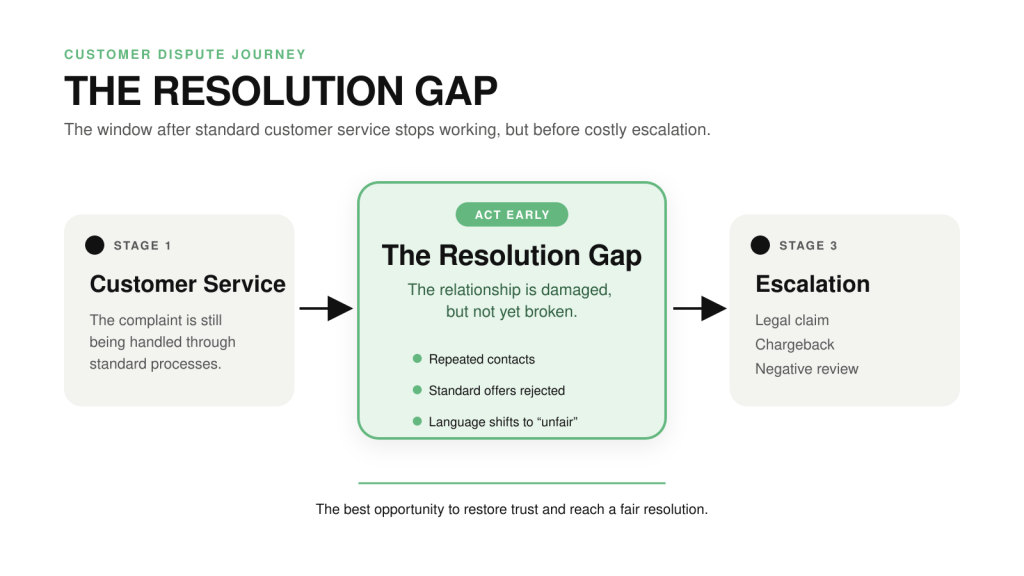
The Resolution Gap

There is a stage in many customer conflicts that most companies do not have a name for.

It begins when normal customer service has stopped working.

It ends when the dispute escalates into a legal claim, regulatory complaint, chargeback, negative review, or public confrontation.

Between those two points, there is a window in which the relationship is damaged, but not yet broken.

I call it the Resolution Gap.

Inside this gap, something predictable happens.

The customer repeats their story.

The company repeats its policy.

The case moves between agents, supervisors, managers, and sometimes legal teams.

Each response may be reasonable on its own. Yet the dispute continues to grow.

From the company’s perspective, it is an unresolved complaint.

From the customer’s perspective, every additional exchange becomes further evidence that nobody is listening or treating them fairly.

This is often the moment when a relatively small disagreement becomes a matter of principle.

The problem is not necessarily a lack of effort.

Most companies have systems designed to provide customer service. They also have processes for managing legal claims.

But few have a structured process for the space in between.

In conversations with business and customer service leaders, I often hear about cases that looked preventable in retrospect.

The warning signs were usually there: repeated contacts, rejection of a standard compensation offer, requests for senior management, and language such as “misled,” “ignored,” or “unfair.”

But the organization did not recognize that the nature of the case had changed.

This may be one of the most important opportunities for AI in customer experience.

Not simply answering customers faster, but identifying when an ordinary complaint is entering the Resolution Gap.

AI can help recognize changes in language and emotion, review the history of the case, identify similar disputes, and support a more structured and fair resolution process.

Once a lawyer’s letter arrives or a complaint goes viral, resolution may still be possible.

But it becomes more expensive, positions become harder, and trust is more difficult to restore.

The window exists.

But it does not remain open for long.

Companies that learn to recognize the Resolution Gap will not eliminate customer conflicts.

They may, however, prevent many of them from becoming crises.

Customers Aren’t Always Fighting Over Money

One idea keeps coming up in my conversations with customer service leaders.

“The customer doesn’t really want a solution. They just want more money.”

I understand why it feels that way.

By the time a customer is demanding compensation, threatening legal action, or posting on social media, it’s easy to assume the dispute is about money.

But in many cases, that’s not where the conflict began.

It started much earlier.

When the customer felt no one was really listening.

When they received a generic response instead of genuine consideration.

When nobody took ownership of their case.

Or when they felt the decision had already been made before anyone had looked at the facts.

At that point, money is no longer just money.

It becomes a symbol, a sign that the company acknowledges something went wrong, has taken responsibility, and is treating the customer fairly.

That’s why so many companies negotiate the amount of compensation while the customer is actually fighting for something else: fairness.

This also explains why a generous compensation offer sometimes fails to resolve a dispute, while a sincere apology, a transparent explanation, or a process that feels fair can completely change the outcome.

The more customer disputes I study and discuss with business leaders, the more convinced I become that the most important question isn’t, “How much does the customer want?”

It’s, “Why are they still fighting?”

Because once you understand what the dispute is really about, finding a resolution becomes much easier.

The Moment a Complaint Becomes a Dispute

One question has stayed with me throughout the many conversations I’ve had with customer service leaders over the past year.

When does a customer complaint stop being a service issue and become a dispute?

Interestingly, almost nobody gives the same answer.

When I meet with customer service executives, I often hear things like:

“Most complaints are easy to resolve.”

“Our agents know how to handle difficult customers.”

“Only a very small percentage become real problems.”

I believe they’re right.

The vast majority of customer complaints never become disputes.

But the few that do can consume an extraordinary amount of management attention, damage customer trust, generate negative publicity, and sometimes end in legal action.

What fascinates me is that the turning point is rarely legal.

It’s psychological.

The moment a customer stops asking:

“Can you help me?”

and starts thinking:

“This company isn’t treating me fairly.”

Everything changes.

The conversation becomes less about the original problem and more about trust.

Customers begin repeating the same facts, not because they haven’t been answered, but because they don’t feel they’ve been heard.

Support agents escalate the case.

Managers become involved.

Legal may eventually step in.

Yet by then, the dispute has often been growing for days or even weeks.

The organizations I’ve spoken with are investing heavily in customer experience, AI, and service quality.

Those investments matter.

But they also raise another question:

Are we equally good at recognizing the moment when customer service ends and conflict begins?

Because identifying that moment may be just as important as resolving the complaint itself.

In many cases, the best opportunity to prevent escalation isn’t after a dispute has formed.

It’s in the brief window before it does.

The Complaints That Matter Most Are Usually the Ones Nobody Owns

Most companies are actually quite good at handling customer complaints.

The vast majority are resolved quickly through customer support.

But those aren’t the complaints that keep CEOs awake at night.

The real risk comes from a small number of cases that don’t fit existing processes.

A customer claims they were misled.

The company believes it acted correctly.

Customer support no longer has the authority to resolve the issue.

Legal is reluctant to get involved too early.

Management only hears about the case after it has already escalated.

The complaint moves from one department to another.

Meanwhile, the customer becomes more frustrated.

Eventually, what began as a routine complaint becomes a negative review, a regulatory complaint, a lawsuit, or a story on social media.

This pattern has appeared repeatedly in conversations I’ve had with CEOs and customer experience leaders.

The problem is rarely that companies ignore complaints.

The problem is that nobody owns the complaints that carry the greatest business risk.

Customer service owns service.

Legal owns litigation.

But who owns the space in between?

As AI reshapes customer experience, perhaps the next opportunity isn’t simply automating customer support.

Perhaps it’s helping organizations identify high-risk disputes early and giving them a structured process before they become crises.

The companies that learn to distinguish between an ordinary complaint and a high-risk dispute may discover that preventing escalation is far less expensive than managing its consequences.

When Customer Service Is No Longer Enough

A few weeks ago, I met with the CEO of a large company.
He proudly described the investments they had made in customer service: faster response times, AI-powered support, better customer satisfaction scores, and continuous improvements to the customer experience.


Then I asked one question.
“What happens when a customer is no longer looking for service, but believes they’ve been treated unfairly?”
The room went quiet.


That conversation wasn’t unique. I’ve had versions of it with many CEOs and customer service leaders over the past year.
And it has led me to a simple conclusion:
Customer service and customer dispute resolution are not the same thing.


My experience as a business mediator has taught me that conflicts rarely begin with money. More often, people want to be heard. They want someone to understand their perspective. Above all, they want to feel that the process is fair.
Only then do they begin talking about compensation.
The same pattern appears in the relationship between businesses and customers.
Customer service is designed to answer questions, solve problems, and provide fast support.
Dispute resolution is different.
The customer is no longer asking:
“Can you solve my problem?”
They’re asking:
“Will you treat me fairly?”
This distinction is supported by decades of research. In Procedural Justice: A Psychological Analysis (1975), John Thibaut and Laurens Walker demonstrated that people’s willingness to accept a decision depends not only on the outcome itself, but also on the fairness of the process that leads to it. Tom R. Tyler later expanded this work, showing that people are far more willing to accept even unfavorable outcomes when they believe the process was respectful, impartial, and gave them a genuine opportunity to be heard.
Yet most organizations still handle disputes using the same tools they built for customer service: support agents, supervisors, email exchanges, and eventually legal departments.
Perhaps that’s why so many companies excel at customer service, yet still struggle when customer relationships turn into conflicts.
As AI rapidly transforms customer interactions, most discussions focus on speed, automation, and cost reduction.
Those are important goals.
But they may not be the most important opportunity.
The more interesting question is whether AI can help businesses and customers reach fair agreements before disagreements become lawsuits, public complaints, or permanently damaged relationships.
If that becomes possible, AI won’t just improve customer service.
It will fundamentally change how businesses resolve conflicts.
Over the coming months, I’ll explore this idea through research, conversations with business leaders, and insights from business mediation.
I have a feeling we’re witnessing the emergence of an entirely new discipline.


References
Thibaut, J., & Walker, L. (1975). Procedural Justice: A Psychological Analysis. Lawrence Erlbaum Associates.
Lind, E. A., & Tyler, T. R. (1988). The Social Psychology of Procedural Justice. Plenum Press.
Tyler, T. R. (2000). “Social Justice: Outcome and Procedure.” International Journal of Psychology, 35(2), 117–125.