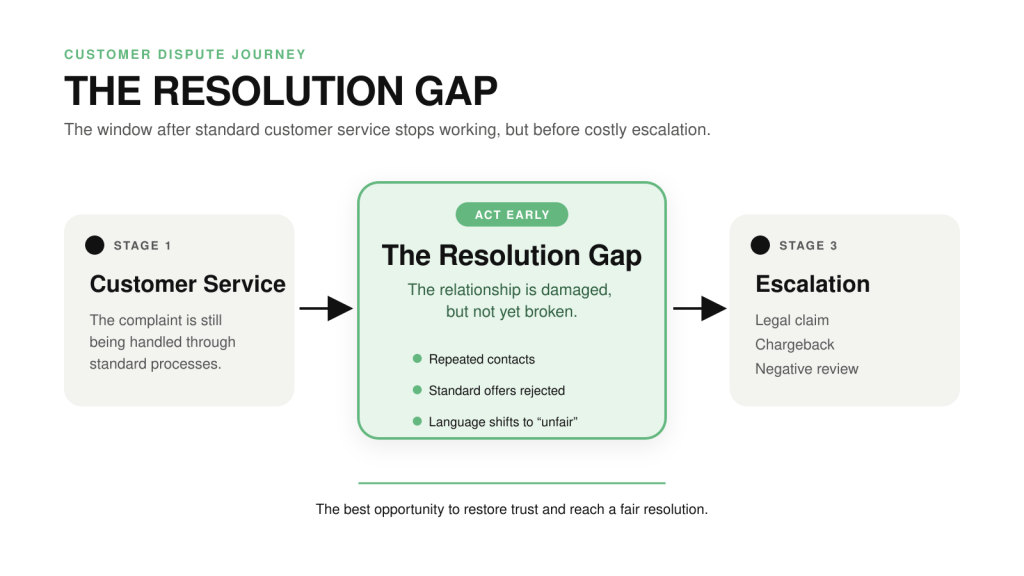
There is a stage in many customer conflicts that most companies do not have a name for.
It begins when normal customer service has stopped working.
It ends when the dispute escalates into a legal claim, regulatory complaint, chargeback, negative review, or public confrontation.
Between those two points, there is a window in which the relationship is damaged, but not yet broken.
I call it the Resolution Gap.
Inside this gap, something predictable happens.
The customer repeats their story.
The company repeats its policy.
The case moves between agents, supervisors, managers, and sometimes legal teams.
Each response may be reasonable on its own. Yet the dispute continues to grow.
From the company’s perspective, it is an unresolved complaint.
From the customer’s perspective, every additional exchange becomes further evidence that nobody is listening or treating them fairly.
This is often the moment when a relatively small disagreement becomes a matter of principle.
The problem is not necessarily a lack of effort.
Most companies have systems designed to provide customer service. They also have processes for managing legal claims.
But few have a structured process for the space in between.
In conversations with business and customer service leaders, I often hear about cases that looked preventable in retrospect.
The warning signs were usually there: repeated contacts, rejection of a standard compensation offer, requests for senior management, and language such as “misled,” “ignored,” or “unfair.”
But the organization did not recognize that the nature of the case had changed.
This may be one of the most important opportunities for AI in customer experience.
Not simply answering customers faster, but identifying when an ordinary complaint is entering the Resolution Gap.
AI can help recognize changes in language and emotion, review the history of the case, identify similar disputes, and support a more structured and fair resolution process.
Once a lawyer’s letter arrives or a complaint goes viral, resolution may still be possible.
But it becomes more expensive, positions become harder, and trust is more difficult to restore.
The window exists.
But it does not remain open for long.
Companies that learn to recognize the Resolution Gap will not eliminate customer conflicts.
They may, however, prevent many of them from becoming crises.